Thursday, August 25, 2011

Friday, August 19, 2011
Inside Job: A film by Leni Riefenstahl
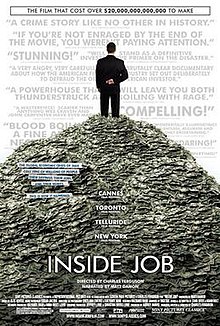
Inside job was not an epiphany. It was more of an afterthought.
I wanted to get some insight or greater understanding to the point
of enlightenment about the condition that rocked and continues to rock
and redefine our world global economies etc. What I got was an
extra grind
Now please note this film is extremely well made. Extremely
beautiful extremely high-quality, creative, inventive in its use of
interview positions, questioners voice present - this is an advanced documentary.
Really.
But the problem is:
When one construct stories that cease to be a quest - when the truth is laid out plainly and clearly and bluntly at the start and reinforced with more and more heavy handed (beautiful) imagery and interview, what are we dealing with?
We're dealing with propaganda.
I don't know where issue pieces like this really lay. where they need to go, what they need to do when a filmmaker comes to the project already knowing what he wants to say.
But it can't be this. It can't come out like this.
It's the same dilemma for fiction filmmakers, novelists, poets. In some way, maybe even explicitly, they know what their story is about, they know what they want to say to their audience. But they cannot explicitly spell it out or it becomes repugnant to the audience - like a bad pill, like bad cheese. Like bad food that that body simply rejects.
This film did not bring me in. Despite its beauty and authority. It only sent me away.
That cannot be what the filmmaker intended.
Someone smart once said, that Symbols must be used in stories and films because they elevate the story to an archetypal level. But if the symbols become explicit and recognizable as symbols, the power reverses and the audience is thrown back down to their terrestrial plane with no insight, noe elevation, and only the sense that symbols are dead.
Don't kill the symbols that you are trying to create.
Dil Chahta Hai: Sublime

Continuing on the Bollywood titles I don't know, the 2001 three person
buddy film titled Dil Chata Hai (The Desires of the Heart). It's a badass film. It's a film's film.
But of course it's more than just that. It's hard to put into words really. The fact that I can't verbalize it might be because I've watched it without subtitles in the whatever Hindi dialectic it must be in. Don't think I'm being just weird: I'm measuring something: I'm measuring the film language itself.
Plus luckily there are a number of english words peppered in along the way. Just enough really to keep me in the loop.
I can see this: He (the director and Amir Kahn, the star) - He's looking for romantic truth. Not just romantic love, or romantic pleasure. Some people look poetic truth or emotional truth, ecstatic truth (think Werner Herzog). This is the searching for romantic truth. And he does so in a three helix shaped maturation plot centering on the transformative power of true romantic love. And daggumit he pulls it off.
It's a gloriously long 3 hours which means: nothing is rushed and montages of togetherness / separation unfurl with utter lack of self consciousness or guile.
Something the Indian filmmakers of this genre seem to understand most is the emotional power of pleasure followed by pain and pain followed by pleasure in increasing dynamics and deepening realness. We FEEL the experiences these young men go through, and their different loves.
What does all this amount to?
Keep several things in mind: Indian cinema is designed as a true experience for the millions and millions who pay good good money to see it. The places, the sights - Goa (the beautiful resort region), the fair with roller coasters, the city and its grandeur, the night clubs and their exotic sexuality, the music - and the dancing.
Listen: The dancing in these movies has a bad wrap in our cynical, faux sophisticated culture. Look: dance and song are older that talking. Dance and song are designed to transcend that which cannot be spoken or demonstrated without rhythm. Our american culture idolizes musical talents as highly as film talents. We just made a divorce between the two in the 70s that we seem unable to mend. Our loss. If you stick with this movie til the Act I climax dance number where Amir Kahn meets HIS transforming love, you will know what I am talking about.
The scale, the sweep, the fact that a seeming Kahn-sibling or Cousin is making a kind of dramatic debut in this film, that Kahn himself - by the way - Amir Kahn is considered one of the top - say - three stars in India. His films are considered the best, highest quality, and his persona is unmatched. And yet he took a back seat in many ways in this film graciously giving time to his two counterparts.
Amir Kahn - it deserves a moment of mention. Kahn is not a star in the same way that we have Brad Pitt. Pitt is a kind of natural, magnetic star. He just looks good, and makes men want to be sexy like him and women want to have sex with him, but we all know there's nothing going on upstairs. Kahn is different. Watching him is like watching Charlie Chaplin act out a contemporary romantic lead. Kahn has the intelligence and the craft to move us as an audience exactly where we need to go. To give us the journey that we have paid for, that we need to go on, to the places we need to see. Kahn as much as guarantees this. This is why his films are considered the best, the highest quality. He is delivering something, like Chaplin did.
All right, enough about Kahn. Now, maybe the print you'll see here in the states will have dirt and hairs on it. Maybe the lighting is not perfect in every scene to our standards, maybe they're using cinemascope lenses from the sixties and it feels all squished and anamorphic like Lawrence of Arabia in the wide shots - I don't care! This is a film's film.
In the end: Three juvenile kids end up three mature men: compassionate, authentic, themselves. It is a maturation plot. And not just "responsible" or "compassionate".
What is great about this film and others like it (read Three Idiots) its that these characters are "Becoming Themselves" in the existential sense. They are going through hardship, trauma and love and becoming more than adult boys. They are becoming the men that only real life plus authentic soul can create. Read Nietzsche.
This story is a pleasure to go through, for we in the audience mature too when a movie is allowed to be three hours long.
Friday, August 12, 2011
Up Yours, Wallander

Oh, Kenneth Branagh, the shame, the scenery chewing. How dissapointed I was when your vehicle remake of an apparently wonderful Swedish detective series turned out to suck.
Granted, my steady diet of Foyle's War has made the prospect of hammy, mousey cryiey complaining in loo of detective work a repulsion to begin with. But was all summed up by one phrase:
Gilding the lily.
All the shots, all the hair, all the costumes, all the plot twists, all were overdoing what was already done. Perhaps they knew they were already redoing a series that was loved and successful. I shudder to think what will result in David Fincher's upcoming similarity.
Suffice it to say this: Kenneth Branagh had a terrible time mugging for this pilot. So did I.
Subscribe to:
Posts (Atom)